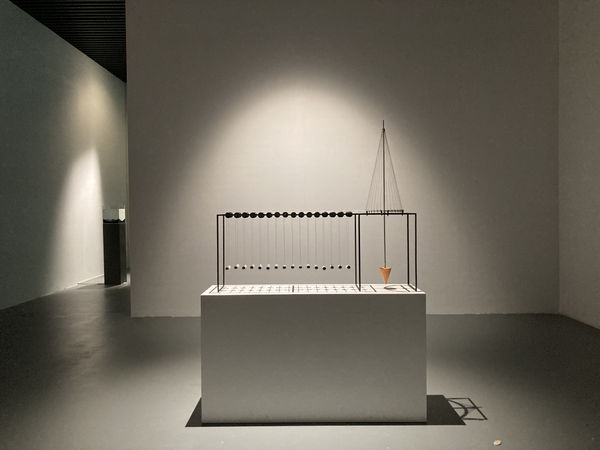
Tang Jie solo Exhibition : A Misty Gaze Into Infinity

On July 4, "Miao: Tang Jie Solo Exhibition" will open at the Powerlong Museum in Shanghai. The exhibition is curated by Tang Yao and presents important installation works by young artist Tang Jie in recent years.
Tang Jie's installation works primarily use natural materials to explore the relationships between people and objects, people and society, and objects and the world. By combining technology with Chinese philosophy and through interaction between the audience and the works, the exhibition playfully stimulates viewers' imagination and evokes reflections on Eastern Zen philosophy.
Curator Tang Yao said: "The debut of 'Origin and End' was truly stunning." In 2013, when Tang Jie graduated from the Luxun Academy of Fine Arts with a bachelor's degree, "Origin and End" won the highest award for sculpture graduates from national art academies—the "Zeng Zhushao Sculpture Scholarship Award." It was subsequently invited to the China Contemporary Young Sculptors Invitational Exhibition, then selected for the "China Posture · The Third China Sculpture Exhibition," where it won another major award and was collected by the Shandong Art Museum. Through the creation of "Origin and End," Tang Jie began to pay attention to broader themes, which later allowed him to create with greater tranquility, to perceive nature with his heart, to understand himself, to comprehend life, and to express more authentically.
Tang Jie has a deep affection for natural materials and pays close attention to materiality. He believes that only by focusing on the materiality of natural materials can one truly understand them and glimpse the essence of natural things. Regarding works such as "As Before" and "Dust at the Spire," when creating this series, although he was outside the space, he often regarded himself as a speck of dust within it. This interplay between the inner and outer spaces of the works is like the human body and soul—existing simultaneously yet each relatively independent.
Tang Jie said: "In artistic creation, the human spirit or thought needs to be embodied in objects. For me, it is more often embodied in natural objects. I adopt a method of 'following the object' in my creation—respecting the object and perceiving it with my heart—so that the object can narrate itself, rather than expressing subjective assertions. The emotions conveyed in this way are purer and more authentic."
Many of his works inspire abundant reverie.
In his creative process, he believes that objects are also narrators. Every natural object possesses its own power, which originates from its inherent materiality and does not shift according to human will. Materiality can be perceived by people, and what the object itself narrates is more genuine than what I express. He said, "Art allows me to perceive life with my heart and find a pure land—a pure land where I can seek my true self and the truth of life." As he interpreted through the words of André: "Perhaps the first person to see through a phenomenon and share its essence creates a great work of art."
Venue: Hall 9, Powerlong Museum, Shanghai
Organizer: Powerlong Museum, Shanghai
Co-organizer: Leo Gallery


-

Tang Jie 湯杰
The Choice of God 上帝的选择, 2014 -
Tang Jie 湯杰 B.1989
Beginning and End 本末, 2013 -
Tang Jie 湯杰 B.1989
Swirling clouds in the haze 云卷云舒, 2019 -
Tang Jie 湯杰
Stone Plan 石头计划, 2014 -
Tang Jie 湯杰 B.1989
Where Way 何途 , 2015 -
Tang Jie 湯杰 B.1989
塔尖上的尘埃
Dust at Top of Tower, 2015 -
Tang Jie 湯杰
Dust in Red 红尘, 2015 -
Tang Jie 湯杰
As Before 如初, 2014 -
Tang Jie 湯杰
Drifting Memories 漂泊的记忆, 2017 -
Tang Jie 湯杰 B.1989
A Water-like Ring 若水之环 , 2019 -
Tang Jie 湯杰 B.1989
Red.White 红白 , 2019 -
Tang Jie 湯杰 B.1989
Stone Story 石语, 2015 -
Tang Jie 湯杰
Dynamic Practice Design 動態實踐設計, 2014 -
Tang Jie 湯杰 B.1989
Grey 灰, 2019