The Primeval Fairy Tale | Shanghai
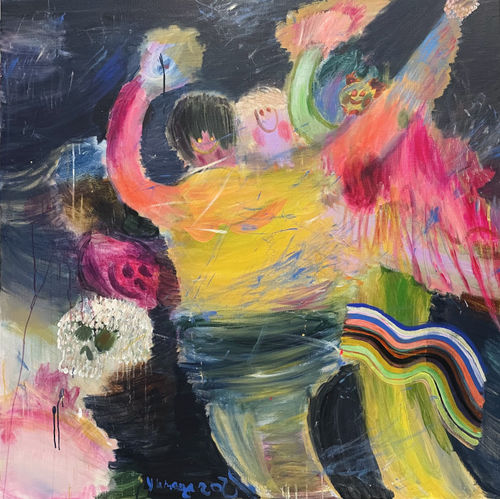
Throughout the history of art, aesthetic ideas and movements that appeal to a primeval style often occur in an attempt for art to find its original power, a reactive correction to excessive delicacy, vanity and pretense in "contemporary" art. After each boom of new creation and style in arts and culture, an attempt to “retrospect to the past” or "trace back to folk traditions" almost always follows. In an effort to create a new narrative, distinct from the styles of the current era, artists form a dialectical logic in the history of aesthetics, going towards the territories of the primal states: ancestral, primitive, folk, dilettante, juvenile, foreign and subconscious. Contemporary art still adopts this logic, which can be regarded as a kind of institutional criticism projected on aesthetics, a continuous return to some archetypal themes.
In this exhibition, some artists show a deliberate use of primeval subject matter and style in order to invoke the power of psychological archetypes hidden in the collective unconsciousness. For example, Wu Wei applies the concept and material of “fur” to religious images and industrial creations, implying the sublime of object that has always been intertwined with barbarism and civilization. Yu Hang combines primeval cultural images with naive graffiti style in an unconscious carnival of brushwork. Their uses of the ancient and the original are embodied in the titles and concepts of substance in their work. Wu Wei’s "Typhon" refers to the demon in Ancient Greek mythology, while Yu Hang names his works in Kiswahili. Although the history of this African language is not as old as people imagine, it has now become one of the symbols of African culture and humanities’ origin.
Deng Wei and Jiang Xiaoyu mobilize experiences based on contemporary life and society: grassroots and corporeal, humorous and honest. In their cases, a kind of carefully controlled unadornment contains a kind of abandonment of over-skillfulness pointing directly into the depth of their hearts. In this sense, Wang Sishun and Yu Yang's works are aimed at the nature of objects and culture. Under the religious title of "Apocalypse", Wang Sishun has searched for various stones embodying characteristics of human portraits from all over the world, discussing the limits of artistic concepts confronting the origin of art and culture. Yu Yang's sculptures bring out a sense of abstract organicity from the materials, in order to obtain a certain non-representational sense of life, the formal results becoming quite primitive in style.
As the theme of the exhibition, "The Primeval Fairy Tale" aims to bring the now subtly reappearing tendency of primitivism into perspective, focusing more on the discourse of art history. In this era when the entire world seems to lose its direction, we return to the natural state, the initial vision and conception in our own way, so that art can stand still amid the chaos.
Text by Bao Dong


-
 Yu Yang 于洋, A Pair of Eyes 一双眼睛, 2017
 -
Yu Yang 于洋, Curve No. 2 曲线2号, 2018
-
Yu Yang 于洋, Curve No. 3 曲线3号 , 2018
-
Yu Hang 于航, Jaball, 2021
-
Yu Hang 于航, Mapenzi Mubashara, 2021
-
Yu Hang 于航, Polepole, 2021
-
Wu Wei 伍伟, Color Lump No.2 色块-2 , 2022
-
Wu Wei 伍伟, Myth No.1 神话-1 , 2021
-
Wu Wei 伍伟, Myth No.2 神话-2 , 2021
-
Wu Wei 伍伟, Color Lump No.1 色块-1 , 2021
-
Wu Wei 伍伟, The Tree of Life No.2 生命树-2 , 2021
-
Wu Wei 伍伟, Tiger Disaster 虎患 , 2020
-
Wang Sishun 王思顺, Apocalypse 15.11.1 启示15.11.1 , 2015
-
Wang Sishun 王思顺, Apocalypse 18.10.1 启示18.10.1 , 2018
-
Wang Sishun 王思顺, Apocalypse 18.8.26 启示18.8.26 , 2018
-
Jiang Xiaoyu 蒋小余, Howl 嚎, 2020
-
Jiang Xiaoyu 蒋小余, Banana 香蕉 , 2019
-
Jiang Xiaoyu 蒋小余, Insomnia 孤盏难眠 , 2021
-
Jiang Xiaoyu 蒋小余, Heart 桃心 , 2021
-
Deng Wei 邓洧, Untitled 无题 , 2020
-
Deng Wei 邓洧, By the Sea 在海边 , 2020
-
Deng Wei 邓洧, Drummer by the Seaside 海边鼓手 , 2021
-
Deng Wei 邓洧, The Third Child 三胎, 2020
-
Deng Wei 邓洧, Untitled 无题 , 2020


